Fixed price vs time and materials: which is right for your project?
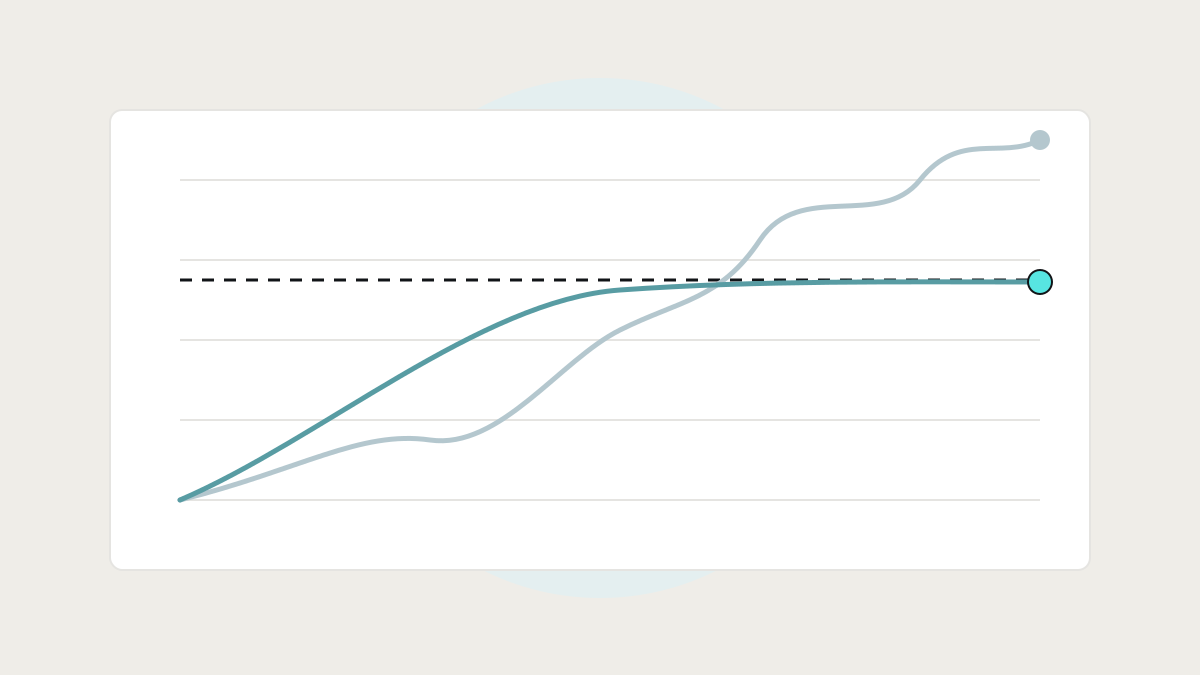
The pricing model decides who carries the risk if software takes longer than expected. How fixed price and time and materials work, the models in between, and how to protect yourself under each.
When you hire someone to build software, the pricing model decides who carries the risk if the work takes longer than expected. Under a fixed price, you agree a scope and a price up front, and the builder absorbs any overrun. Under time and materials (T&M), you pay for the hours actually worked, so you absorb it. Neither is always better. The right choice depends on how well the work can be defined before it starts.
This guide explains how each model works, what the research says about overruns, the hybrid models in between, and how to choose and protect yourself under each.
What the research says about software overruns
- Average overruns hide extreme ones. Bent Flyvbjerg and Alexander Budzier analysed 1,471 IT projects. The average cost overrun was 27%, but one in six was a "black swan", with an average cost overrun of 200% and a schedule overrun of almost 70%. (Flyvbjerg and Budzier, Harvard Business Review / arXiv) The question isn't just "what's the likely cost?" It's "who pays if this goes badly?"
- Unclear requirements drive most failures. PMI's 2014 Pulse of the Profession in-depth report found that when projects miss their goals, inaccurate requirements management is the primary cause almost half the time (47%). (PMI) That's exactly the uncertainty a pricing model has to deal with.
How fixed price works
You and the builder agree a written scope: what will be built, what "done" means, and what's excluded. The builder quotes one price, usually paid in milestones. If it takes longer than they estimated, that's their cost. If you want something outside the scope, it's priced as a change before it's done.
Good for you when:
- The work can be described clearly up front.
- You need budget certainty, for a board, a lender or your own cash flow.
- You don't want to manage a builder's hours week to week.
Watch out for:
- Vague scope. A fixed price is only as fixed as the scope is clear. Vague scopes lead to arguments about what was included.
- Padding. Builders price in risk, so a fixed price for uncertain work can be higher than T&M would have been.
- Rigidity. Changing your mind mid-project means change requests. That's healthy, but it needs a simple process.
- Corner-cutting. A builder losing money may be tempted to rush testing. Agree quality standards in writing.
How time and materials works
You pay an agreed rate for the time spent, usually billed weekly or monthly, plus any costs like software licences. The scope can change as you learn, and you only pay for what's done.
Good for you when:
- The work genuinely can't be defined up front, such as research, an early-stage product, or ongoing improvements.
- You want to change priorities often.
- You trust the builder and can stay closely involved.
Watch out for:
- No ceiling. Without a cap, the total is open-ended, and the overrun risk is yours.
- Weak incentives. Efficiency doesn't change what the builder earns.
- Management effort. You need to review progress and hours regularly to keep it under control.
The models in between
Most good arrangements mix the two:
- Paid discovery, then fixed price. A short, paid scoping phase produces a prototype, a written plan and a fixed price for the build. You only commit to the big number once the uncertainty is gone.
- Fixed price per phase. The project is split into phases, each fixed-priced once the previous one is done and the next is understood.
- Capped time and materials. You pay for hours worked, up to an agreed maximum. Above it, the builder carries the cost or a change is agreed.
- Retainer. A fixed monthly amount buys a set amount of capacity for ongoing improvements and support after launch.
How to choose
- A clear, well-understood scope, such as replacing a known spreadsheet process: fixed price.
- A rough idea that needs shaping first: paid discovery, then fixed price for the build.
- Several stages, each depending on what you learn: fixed price per phase.
- Ongoing improvements to software already running: a retainer, or T&M with a monthly cap.
- Pure research or experimentation: time and materials, with a cap and regular check-ins.
How to protect yourself under either model
- Write down the scope, including what's not included. Our requirements document template helps.
- Define "done": what you'll test, and with which real examples.
- Agree how changes work: who can request them, how they're priced, and that nothing is built before the price is agreed.
- Pay in milestones tied to working software you can see, not to time passing.
- Make sure you own the code once it's paid for, and that you get access to it throughout. See our software development contract checklist.
- Agree what happens after launch: fixes, hosting, support and how they're paid for.
- Under T&M, set a cap and a reporting rhythm, such as weekly hours and progress against the plan.
Questions to ask a builder
- What exactly is included and excluded?
- What assumptions is the price based on? Assumptions that turn out wrong are where costs move.
- How do you handle changes?
- What happens if you underestimate?
- How is the work tested, and how do I check it?
- Who owns the code, and when?
- What does support after launch cost, and what's covered free?
How we price at Lephlo
We give fixed prices, because we think the overrun risk on a defined piece of work belongs with the builder, not the client. We don't price anything until we understand it. It starts with a free consultation about how the work happens today. For a clear, focused project, we send a fixed price for the agreed scope. For complex or unclear projects, we suggest a short, paid Scoping Sprint first: a clickable prototype, a build plan and a fixed price, with the Sprint's fee credited to the build.
Changes are priced before we do them, so there are no surprise invoices. You own the code, and fixes are free during the fix period after launch. For ongoing improvements, we offer monthly care plans and retainers.
We build internal tools, customer portals and integrations that connect to the tools you already use. Related reading: how much custom software costs. To size a first version, try the Build Scope Planner, or book a free consultation.
Frequently asked questions
Is fixed price more expensive than time and materials? Sometimes, because the builder prices in risk. For clearly defined work, the difference is usually small, and you get certainty. For unclear work, a fixed price is either padded or unreliable, which is why paid discovery first makes sense.
What is a change request? A formal request to change the agreed scope, with its cost and impact on the timeline agreed before the work is done.
Can a fixed-price project be agile? Yes. You can work in short cycles and review progress every week or two within a fixed scope and price, swapping items of similar size through the change process.
What is a capped time and materials contract? You pay for time spent, up to an agreed maximum. It combines some of T&M's flexibility with some of fixed price's protection.
Sources
- Bent Flyvbjerg and Alexander Budzier, Why Your IT Project May Be Riskier Than You Think, Harvard Business Review (2011)
- Project Management Institute, Pulse of the Profession In-Depth Report: Requirements Management (2014)